
Conversation Is Thinking. Ads Are Interruption. Can They Coexist?
A playbook for monetizing AI without cognitive interference

If you watched the Anthropic ads before tonight’s big game, you saw a line in the sand: “Ads are coming to AI. But not to Claude.” This is not just marketing. It recognizes a simple design law: there is a massive difference between the Search surface and the Conversational surface.
Search monetizes attention. Conversation monetizes trust.
In a Search engine, an ad is an expected part of a directory. You are scanning a list, and sponsored links have been part of that contract for decades. In a conversational interface, you are in deep thinking mode. You are not browsing. You are reasoning.
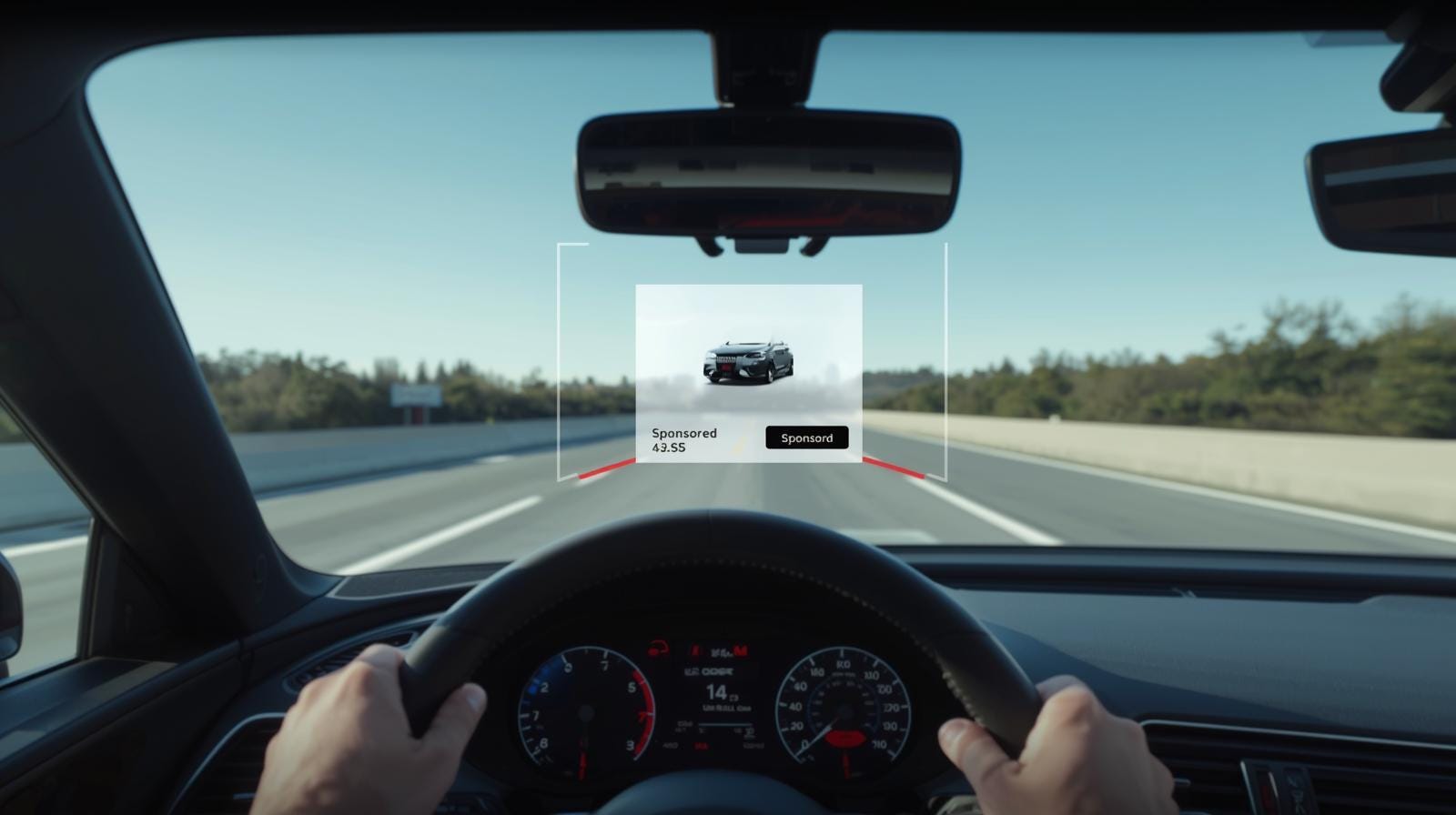
To see why the surface matters, think about your car’s windshield as an interface. Many newer cars use a heads-up display (HUD): a transparent projection on the windshield that shows critical information like speed, navigation, or lane guidance directly in your line of sight. The whole point of a HUD is simple: keep your eyes on the road while still giving you the information you need. In the rest of this piece, I will walk through three HUD-inspired scenarios and then outline the strategy and system architecture that show how AI platforms can monetize without breaking that focus.
Scenario 1: The Premium Surface (User Pays)
In this scenario, the user pays to own the vehicle and their windshield. Before I had a HUD, my focus was fractured and dangerous. I had to look down at my phone for Google Maps or glance away at a vehicle GPS constantly. Every time I looked down, I was blind to the road for a split second. I was absolutely willing to pay extra for a HUD because it preserved my focus.
This is the subscription experience for AI: users pay for a premium, ad-free surface because they are buying the right to never look down. In AI, “looking down” is a cognitive danger. When a user has to leave the chat to verify an output in another tab, they are taking their eyes off the road. They pay to keep the surface clean so their reasoning remains uninterrupted.
Scenario 2: The Sponsored Ad (Utility-Driven)
In this alternative scenario, a sponsored ad appears but it is one that you actually accept. Imagine your vehicle notices your eye contact shifting away from the road because you are trying to find a charging station or a specific rest stop on your phone. The system recognizes you are struggling. Instead of a random billboard, a sponsored ad for a premium charging network or a service center pops up directly on your HUD. This ad is a surgical solution to the danger the car just watched you encounter. You accept this sponsored ad because it allows you to buy the upgrade or navigate to the solution without ever looking down.
This is the ad-supported experience for AI: users accept a highly relevant, sponsored ad because it resolves their intent without forcing them to look away. On AI surfaces like OpenAI or Claude, this would be a sponsored tool or link that appears only when you are about to “look down” to another tab to finish a task. The sponsor earns their place on your surface because their ad resolves your immediate intent and restores your safety.
Scenario 3: The Just-In-Time Upgrade (Platform Conversion)
In this final scenario, the vehicle uses your behavior to prove the value of the upgrade. Imagine you chose not to pay for the HUD, but the cabin camera continues to track how often you look down at your phone while driving. After a week, the car presents a personalized safety report: “You spent 14 minutes looking away from the road this week. Drivers with a HUD reduce this risk materially. Would you like to add the Focus Package now?”
This is the conversion engine for AI: the platform uses real utility data to move users from the ad-supported model to the premium model. Instead of a blind sales pitch, the AI shows you exactly how many times you had to “look down” to other tabs to verify facts. By showing you the cost of your own distraction, the platform makes the premium subscription an obvious, informed decision for your own safety and productivity.
The Danger: Cognitive Interference
The moment you monetize the surface with traditional, intrusive ads, you compromise the operational integrity of the windshield.
Cognitive interference is any monetization pattern that competes with your current intent and forces you to “look down.” If your HUD starts pitching a “sponsored hotel” that obscures lane markings during a storm, you lose trust. This is the digital equivalent of a system failure. This remains true whether you paid for the surface or a sponsor provided the ad. When the interface prioritizes a sponsor’s mission over your focus, the reasoning utility degrades. This is no longer an interface annoyance; it is a safety hazard for your productivity.
The Strategy: The Value-Aligned Funnel
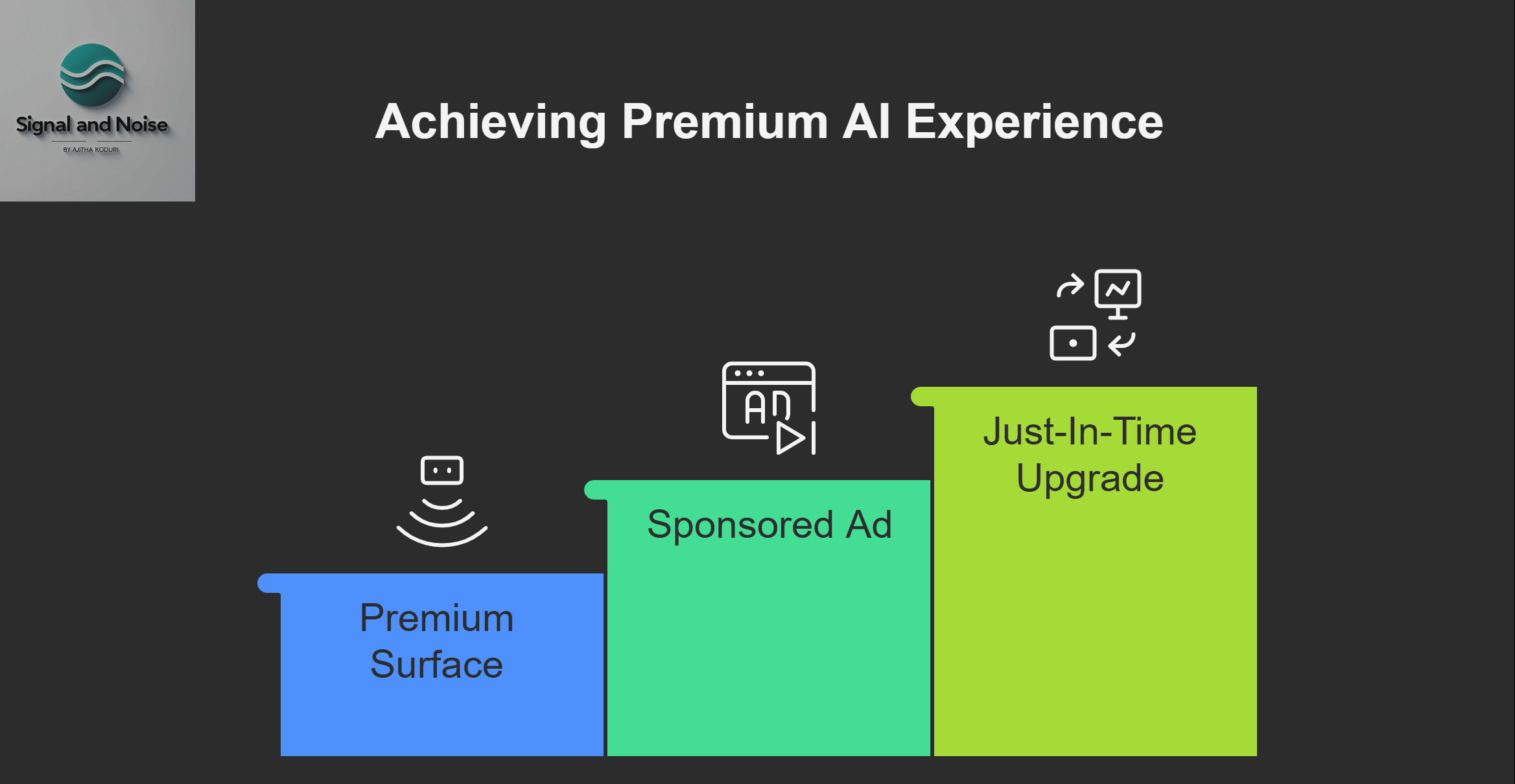
Platforms do not need to interrupt reasoning to monetize. The value progression is simple:
Premium Surface (Scenario 1): The user buys a “sacred space” and owns the entire surface, ensuring no third party interrupts the reasoning flow.
Sponsored Ad (Scenario 2): For free users, the platform allows only surgical placements that resolve immediate friction inside the flow.
Just-In-Time Upgrade (Scenario 3): The platform uses friction data to show the cumulative cost of distraction and converts the user with proof, not persuasion.
The Ecosystem Architecture
As AI technology becomes a commodity, the Engine is no longer the product. The product is the Integrity of the Surface under load.
4.1 The Three Agents
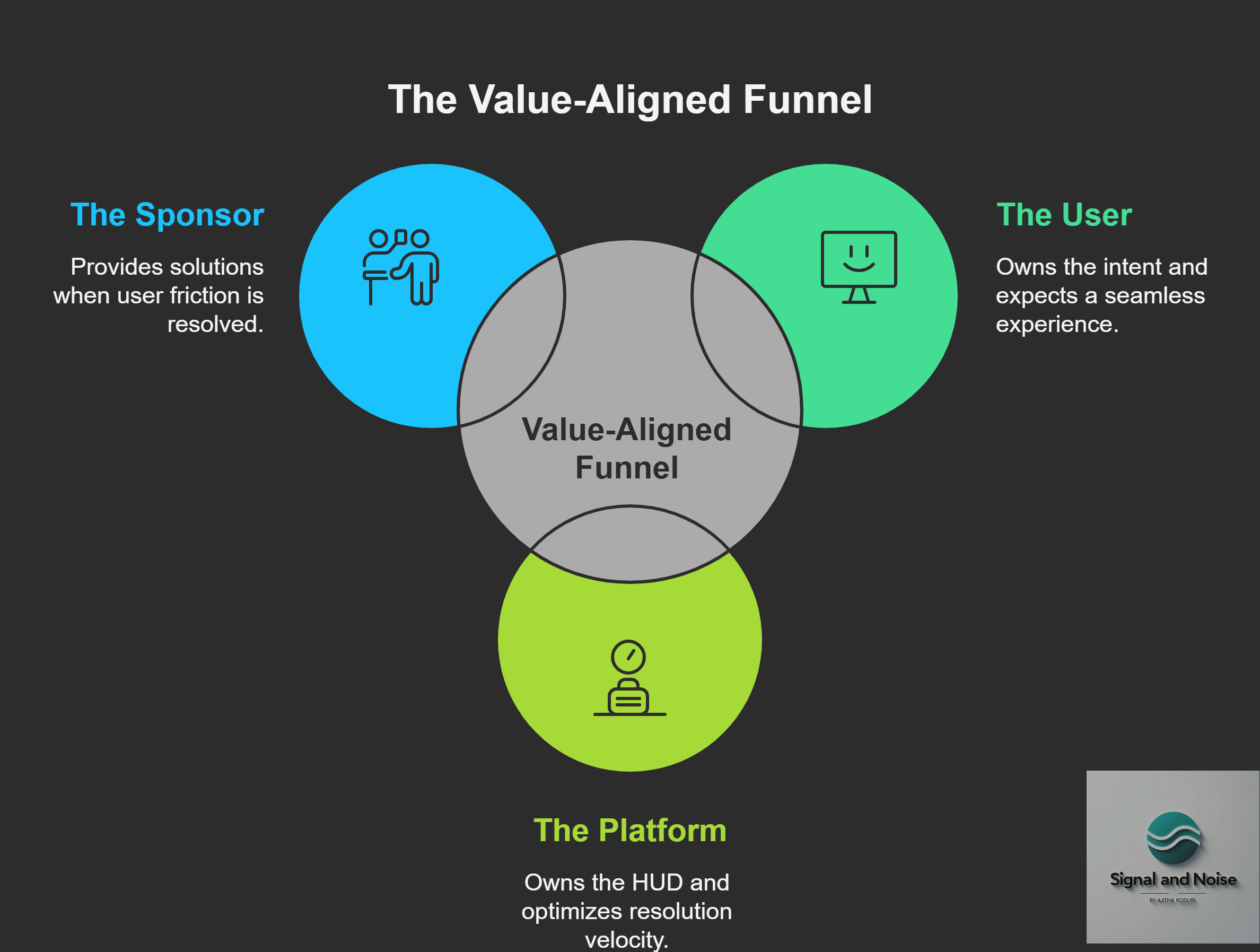
The Platform acts as the control plane, balancing three interests that are now aligned by utility:
The User: Owns the intent and expects a “no-look-down” experience.
The Platform: Owns the HUD and optimizes Resolution Velocity, ensuring the reasoning flow remains unbroken.
The Sponsor: Provides the solution only when it resolves a specific user friction or intent.
The following section details the technical architecture for the Intent-Arbitration Engine and the Spatial HUD model. This playbook is designed for AI labs, retail aggregators, and platform architects building sponsored systems who need to monetize reasoning while maintaining surface integrity. By following these spatial rules and conversion metrics, platforms can replace distracting ads with surgical utility and use behavioral data to turn free users into premium subscribers.
